

Ticking clocks. Alien radio. Grief. Pluribus S01E01: “We Is Us” doesn’t just toss you into an apocalypse — it yanks you by the collar and introduces you to its own strange brand of horror. But there’s wit, sadness, and biting humor jammed into every minute. So let’s set up our own countdown: this is exactly what happens in that wild first hour, as the world changes for everyone except one stubborn, lonely writer. Buckle up.
Welcome to the Countdown
First things first: the show opens with a timer superimposed against the sky. Not explained, just ticking. You see “439 Days, 19 Hours…” and you immediately know something massive will land when that clock hits zero. The air already feels wrong.
Out in New Mexico, two sleep‑starved SETI astronomers squint at weird radio data. One guy with big “I haven’t slept for days” energy tries to convince his buddy it’s all a glitch. However, the signal refuses to behave like background noise or a cosmic burp. It repeats. Every 78 seconds, always the same pattern.
That’s the moment things start to tip from “maybe a Russian satellite” into pure sci-fi. The scientists debate, decode, and — bit by bit — discover something no human has ever seen. And they do it with enough jokes and exasperation to make even the tension feel weirdly familiar.
Eventually, someone cracks the pattern. The four frequencies? They’re not just dings and pings. They map perfectly onto the way RNA encodes genetic information — with four bases, not two. This isn’t a message in a bottle. It’s a recipe for biology. So what do the boffins do with that? Of course, they build it. Because curiosity will always win out over caution in TV labs.
Laboratory Boredom Breeds Catastrophe
Let’s fast forward. The timer now flashes “79 Days to Go.” We jump to a military infectious disease lab, where things seem… dull. Lab techs munch snacks. They complain about protocols. For eight months, they’ve injected lab‑grown virus into rats, expecting some mutant to go full Godzilla. Nothing happens — at least until the moment one poor rat keels over. Dr. Jenn is on it in flash, but she breaks the tiniest rule: She checks for a heartbeat without gloves.
Guess what happens next? Yup, the rat bites. Jenn instantly collapses into a shaking fit. Her boss, Dr. D, hauls her into quarantine and blasts her down with disinfectant showers. Mere seconds later, Jenn recovers. She moves with a peculiar calm. And that’s when everyone else in the facility catches it — one at a time. Not with menacing growls, but with kisses, handshakes, and friendly contact.
The camera lingers as their small team transforms. Colleagues kiss, swap swabs, and start prepping the “virus” for mass delivery. But nobody is screaming or fighting. They all move with intent. The camera captures a dystopian version of office teamwork. In a darkly comic twist, Jenn even licks every doughnut in the break room to guarantee future spread. Cheeky, efficient, terrifying.
And there it is: not a zombie outbreak, but something more deeply disturbing — friendly, competent, and apparently unstoppable.
Carol Sturka Hates Crowds, Suddenly Faces One
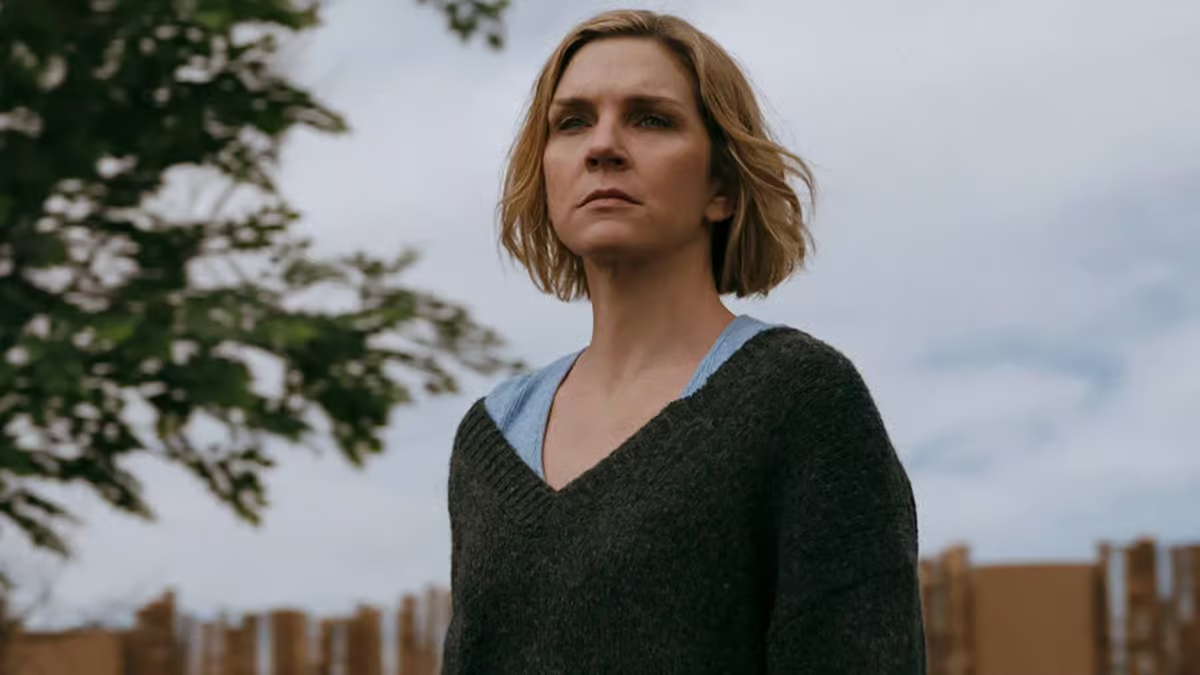
We finally meet Carol Sturka, the reluctant star of this tale. She sits in a bookstore, reading from her own Stardust-level fantasy romance series. Her fans devour every word. Carol, however, seethes with self-irony. She rolls her eyes at every “thank you” and quietly mocks her own books when no one’s listening.
So what defines Carol? Three things stand out right away:
- Massive success.
- Zero self-confidence.
- A finely honed instinct to run away from connection.
Her partner and agent, Helen, wrangles eager fans. Helen oozes pride but also carries an undertone of care — she protects Carol from the worst while nudging her toward honesty and self-appreciation. In their downtime, Helen suggests Carol ditch the fantasy schlock for something serious — her never‑published manuscript, “Bitter Chrysalis.” For Carol, these words sting, hovering somewhere between hope and threat.
The Day Gets Strange — And Then Nightmarish
Transition to Albuquerque. The couple checks into a rental car (the one with the breathalyzer, a sharp hint that Carol’s drinking is an ongoing plot wrinkle). They end up at a bar — Carol ordering rye, Helen sipping soda. Helen tries to map out a future beyond endless signings; Carol, predictably, mocks herself again.
But weirdness outside ramps up fast. The news blares about lockdowns at a local airbase. Carol notices jet trails above, but these aren’t normal — they’re computer-perfect, gridline‑straight, and fill the sky in a way that gives her chills.
Right then, a pickup truck plows into a parked car meters away. The driver convulses. Just as quickly, Helen collapses too, left twitching helplessly on the pavement. Carol’s programmed to panic, and she does — loud and desperate.
She drags Helen to the hospital herself. Inside, it’s all gone wrong: the waiting room resembles a wax museum, with staff and patients alike seized by convulsions. She begs the lone, conscious doctor for help. Within seconds, he succumbs just like everyone else. Carol stands alone — utterly, viscerally.
Helen’s seizures suddenly stop. She sits up, beams a reassuring, uncanny smile, and then — just like that — dies. Quietly. No final words. Just absence.
Hive Mind, Served With a Smile
Outside, the world flickers back to life. All the comatose patients and staff now walk, stand, and move with eerie grace. Their voices synchronize. Dr. Nguyen, who’d just slumped unconscious, smiles warmly and tries to kiss Carol—“to help.” Everyone in the hospital turns and walks toward her as one. The “help” mantra repeats, growing more unsettling with every gentle step.
Carol bolts for the exit. The now-calmed crowd parts and watches her fly off into the ruined streets.
Back home, things just get weirder. Carol, keyless, bludgeons her own door with a rock. Neighbor kids across the cul‑de‑sac emerge, their words perfectly matched, inquiring with robotic politeness about her spare key. As she finally steps inside, every house on her street empties. People fill their cars, and in perfect harmony, they all roll out at once — leaving her with total silence. The world has organized itself out of her sight.
Davis Taffler Delivers a Hard Sell
Finally, the episode’s creepiest moment appears on Carol’s TV. Davis Taffler, now the hive mind’s smiling avatar, FaceTimes right onto her screen. His delivery drips with calm, PR-speak charm.
He lays it out: The event is called “The Joining.” Almost everyone, everywhere, now shares the same mind and mission. Only a slim handful of “uninfected” remain — Carol counts as number twelve nationwide.
What do the “Joined” want? To help. Always. Without exceptions, queries, or hesitation.
Davis assures Carol — no, we won’t force you, not yet. But clearly, they’ll keep “inviting” her. His promise hovers, half-friendly, half-threatening: stay untouched, but always in view. Safety guaranteed — unless, of course, she ever wants to give up her fierce independence.
Chilling Details, Sudden Jumps, and So Many Kisses
The first episode packs moments that stick for days. Several details keep surfacing in reviews and social media chatter:
- The Lysogenic Virus: In real science, a lysogenic virus embeds in host DNA and often stays silent for ages. Pluribus turns this real-world twist into a metaphor for forced social connectivity.
- The Synchronized Kindness: It’s the “nicest” invasion possible. “We just want to help, Carol” lands as both comfort and threat.
- The Inescapability: Critics at Looper point out how the “black box” logic — ‘it just works’ — recalls modern conversations about opaque tech and groupthink.
- The Victim List: Stats drop so casually you could miss it: almost everyone joins. Eleven others (besides Carol) worldwide resist.
- Rhea Seehorn’s Flex: That face! One reviewer wrote she can “flip between scathing sarcasm and total heartbreak in half a sentence.” Here, she does it in half a scene.
So, not just the scares — the writing twists the knife with dark comedy and emotional honesty.
Unanswered Questions and Eerie Threads
“We Is Us” draws hard lines around what this story will be. Alone-ness? Suddenly unthinkable, almost illegal. Grief? Now it’s a problem for everyone to fix. Individual thought? Dangerous — if you believe in the hive’s mission.
But the show swings smart, never letting one mood dominate:
- There’s horror, in how help and kindness become weapons.
- There’s longing, in Carol’s isolation after years of avoiding connection.
- There’s brutal comedy, in how even her least favorite parts of herself now separate her from everyone else on Earth.
Going into episode two, a lot hangs in the balance. What happens to the other “immunes?” Will Carol ever trust anyone again? Is this “help” ever going to look like a real choice? And maybe most urgently, can you ever outsmart a world that literally wants the best for you, whether you like it or not?
Now That the Clock Is Counting Up…
Here’s what strikes hardest after all the chaos of “We Is Us:” For most, the world ends and simply restarts, happier, sounder, and connected. But for Carol, the end of the world means a deep, echoing silence. Her personal apocalypse isn’t fire and brimstone — it’s relentless offers of compassion she can’t accept. Resistance turns into her only act of faith.
And as the clock finally switches — no longer counting down to disaster, but up from it — you know the rest of Pluribus will dig deeper into what “I,” “We,” and “Us” even mean.
So pour another rye. Someone out there still gets to decide for themselves, at least for now. And we’ll be sitting right next to Carol as the story unfolds.